

Network Setup
Connect your SenseAi Embedded to the internet via WiFi or 4G/LTE router
Overview
SenseAi Embedded requires an internet connection to send data to the IoTFlows cloud. You have three connectivity options:
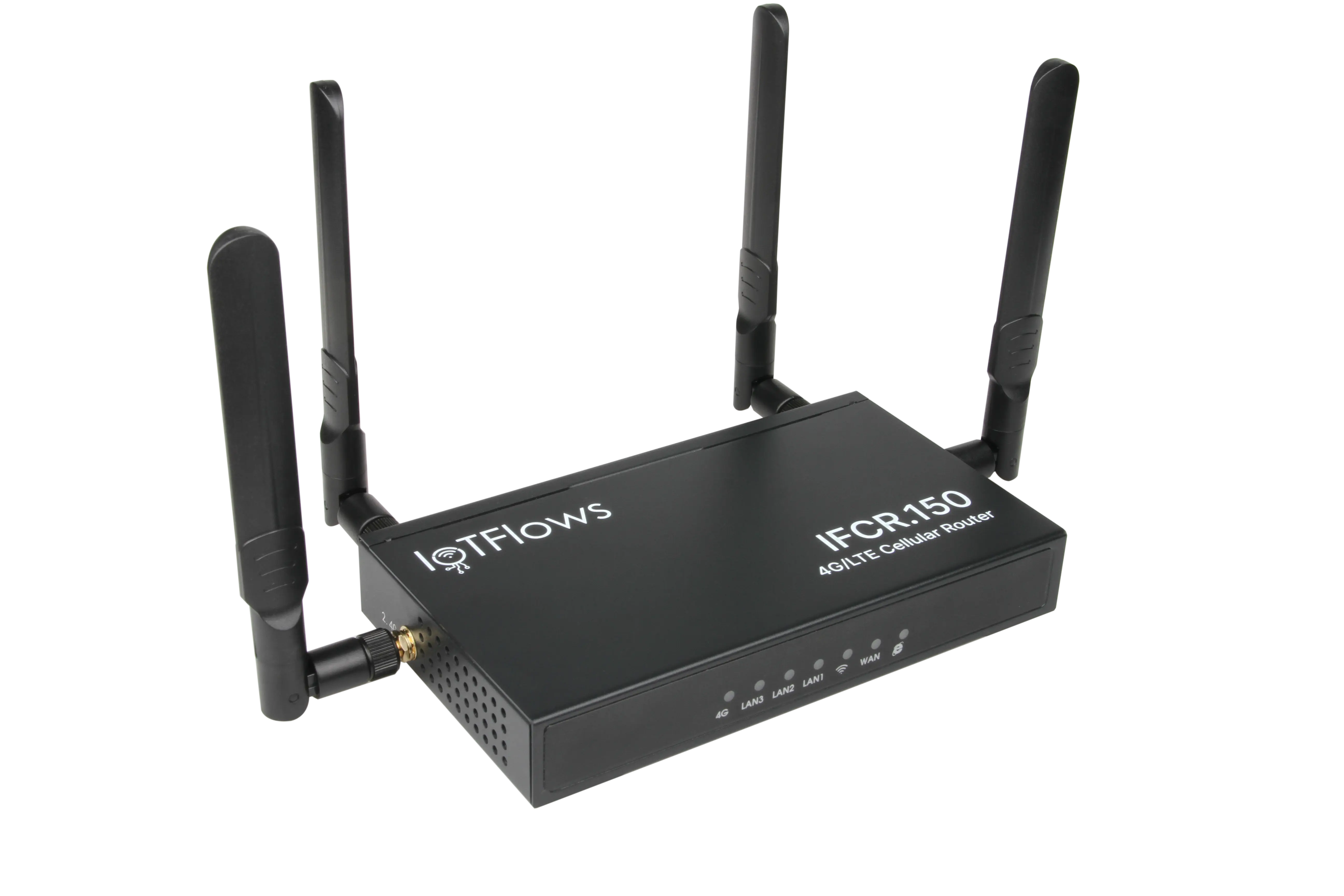
- Option 1: IoTFlows 4G/LTE Router (plug & play, no configuration)
- Option 2: Facility WiFi (2.4 GHz only)
Option 1: Using IoTFlows 4G/LTE Router
If your SenseAi Embedded ships with an IoTFlows 4G/LTE router:
- Connect the router's power adapter
- Place it near a window or spot with good cellular reception
- Keep it within 100 ft (30 m) of your SenseAi Embedded devices
- Power up your SenseAi Embedded unit
The router automatically connects to the cellular network within a few minutes. Once active, SenseAi Embedded connects to the router's WiFi and appears online in your IoTFlows dashboard.
Option 2: Connecting to Facility WiFi
If you prefer to use your facility's WiFi network:
Requirements
- WiFi network must be 2.4 GHz (5 GHz not supported)
- IoTFlows Mobile App installed on your phone
- Bluetooth enabled on your phone
Setup Steps
-
Download the IoTFlows Mobile App:
-
Log in with your IoTFlows account
-
Enable Bluetooth on your phone
-
In the app, navigate to: Settings → Devices → Connect Device to WiFi
-
Select SenseAi Embedded from the device list
-
Ensure your SenseAi Embedded is blinking blue (WiFi setup mode)
- If not blinking blue, see "Resetting WiFi Configuration" below
-
Follow the in-app prompts:
- Select your WiFi network from the list
- Enter your WiFi credentials
- Wait for confirmation
-
Connection established! The LED will go through the connection sequence
 |  |  |  |
|---|
LED Status Reference
Understanding LED indicators helps you track connection status:
| LED Status | Meaning | What to Do |
|---|---|---|
| Blinking Blue | WiFi setup mode — ready to receive credentials | Use mobile app to configure WiFi |
| Flashing Red (every few seconds) | Attempting to connect to configured WiFi | Wait for connection (up to 2 minutes) |
| Orange → Green → White → Cyan (blinking sequence) | Successfully connected to WiFi, establishing cloud connection | Wait for stable light |
| Stable Cyan | Connected and online — machine is idle | Normal operation |
| Stable Orange | Connected and online — machine is running | Normal operation |


Resetting WiFi Configuration
To switch from WiFi to 4G/LTE router (or reset to factory defaults):
- Press and hold the WiFi button for 10 seconds
- LED will blink purple, then turn red after 10 seconds
- Release the button
- Device will reboot and restore default credentials (connects to IoTFlows 4G/LTE router)
To switch from 4G/LTE router to WiFi (or change WiFi networks):
- Press and hold the WiFi button for 10 seconds
- LED will blink purple, then turn red after 10 seconds
- Release the button
- Device will reboot into WiFi Setup Mode (blinking blue)
- Use mobile app to configure new WiFi credentials
Troubleshooting
Device Won't Enter WiFi Setup Mode
Symptoms:
- LED not blinking blue when expected
- Can't find device in mobile app
Solutions:
- Press and hold the WiFi button for full 10 seconds
- Wait for LED to blink purple, then turn red
- Release button when LED turns red
- Device should reboot into WiFi setup mode (blinking blue)
If still not working:
- Try power cycling the device (disconnect and reconnect power)
- Ensure you're holding the correct button (WiFi button)
- Check that device has power (power LED should be on)
Cannot Connect to WiFi Network
Symptoms:
- Device stuck on flashing red LED
- Mobile app shows connection failed
- Device not appearing in dashboard
Solutions:
1. Verify Network Compatibility:
- Confirm your WiFi is 2.4 GHz (not 5 GHz)
- Check that network is not hidden
- Ensure network uses WPA/WPA2 security (WEP not supported)
2. Check WiFi Password:
- Re-enter password carefully in mobile app
- Watch for typos (case-sensitive)
- Try copying/pasting password if available
3. Check Router Settings:
- Ensure router allows new device connections
- Check if MAC address filtering is enabled (add SenseAi Embedded MAC address)
- Verify DHCP is enabled
- Check firewall isn't blocking IoTFlows traffic
4. Check Signal Strength:
- Move SenseAi Embedded closer to router temporarily
- Ensure router is within 100 ft (30 m)
- Check for physical obstructions (metal walls, equipment)
WiFi Connection Drops Frequently
Symptoms:
- Device shows offline intermittently
- Data gaps in dashboard
- LED alternates between connected and disconnected states
Solutions:
1. Improve WiFi Signal:
- Move router closer to SenseAi Embedded
- Reduce physical obstructions
- Consider WiFi range extender
- Check for interference from other 2.4 GHz devices
2. Check Router Health:
- Restart router
- Update router firmware
- Check for too many connected devices
- Verify internet connection stability
3. Alternative Solutions:
- Consider switching to IoTFlows 4G/LTE router for more reliable connectivity
Device Shows Offline in Dashboard
Symptoms:
- Dashboard shows device as "Offline"
- No recent data updates
- LED shows stable cyan or orange
Solutions:
- Check LED status - if stable cyan/orange, device thinks it's connected
- Refresh dashboard page
- Check internet connection - ensure router has internet access
- Power cycle device - disconnect and reconnect power
- Check IoTFlows cloud status - visit status page
- Wait 5-10 minutes - device may be reconnecting
Network Security
Data Encryption:
- All data transmitted via HTTPS/SSL
- End-to-end encryption from device to cloud
- Secure authentication protocols
Network Requirements:
- Outbound HTTPS (port 443) must be allowed
- No inbound ports required
- Works with most corporate firewalls
Next Steps
✅ Device is now connected!
Continue to Calibration to fine-tune the parameters of your device for optimal accuracy